Bachata began in the Dominican Republic as music and a social dance. As it spread internationally, teachers and performers developed new approaches to the basic rhythm, connection and body movement. The names can be confusing because studios use “traditional”, “Dominican”, “modern” and “sensual” with different degrees of precision.
The clearest way to compare bachata styles is to look at what happens in the feet, torso, partnership and music—not at costumes or how close the dancers stand.
What all bachata styles share
Most social bachata uses four-beat groupings: three weight changes followed by a tap, touch or accented step on 4, then the pattern repeats in the other direction through 8. Dancers can rotate, travel or stay in place, and the accent does not have to be an exaggerated hip lift. Our guide to Bachata weight transfer, grounding and the tap gives a five-minute drill for keeping those actions clear.
UNESCO placed the music and dance of Dominican bachata on its Representative List of the Intangible Cultural Heritage of Humanity in 2019. UNESCO describes the music as a fusion of rhythmic bolero with other Afro-Antillean genres, traditionally led by guitar with percussion and bass. Our guide to Bachata’s derecho, majao and mambo rhythms shows how those instruments shape a song.
Dominican bachata
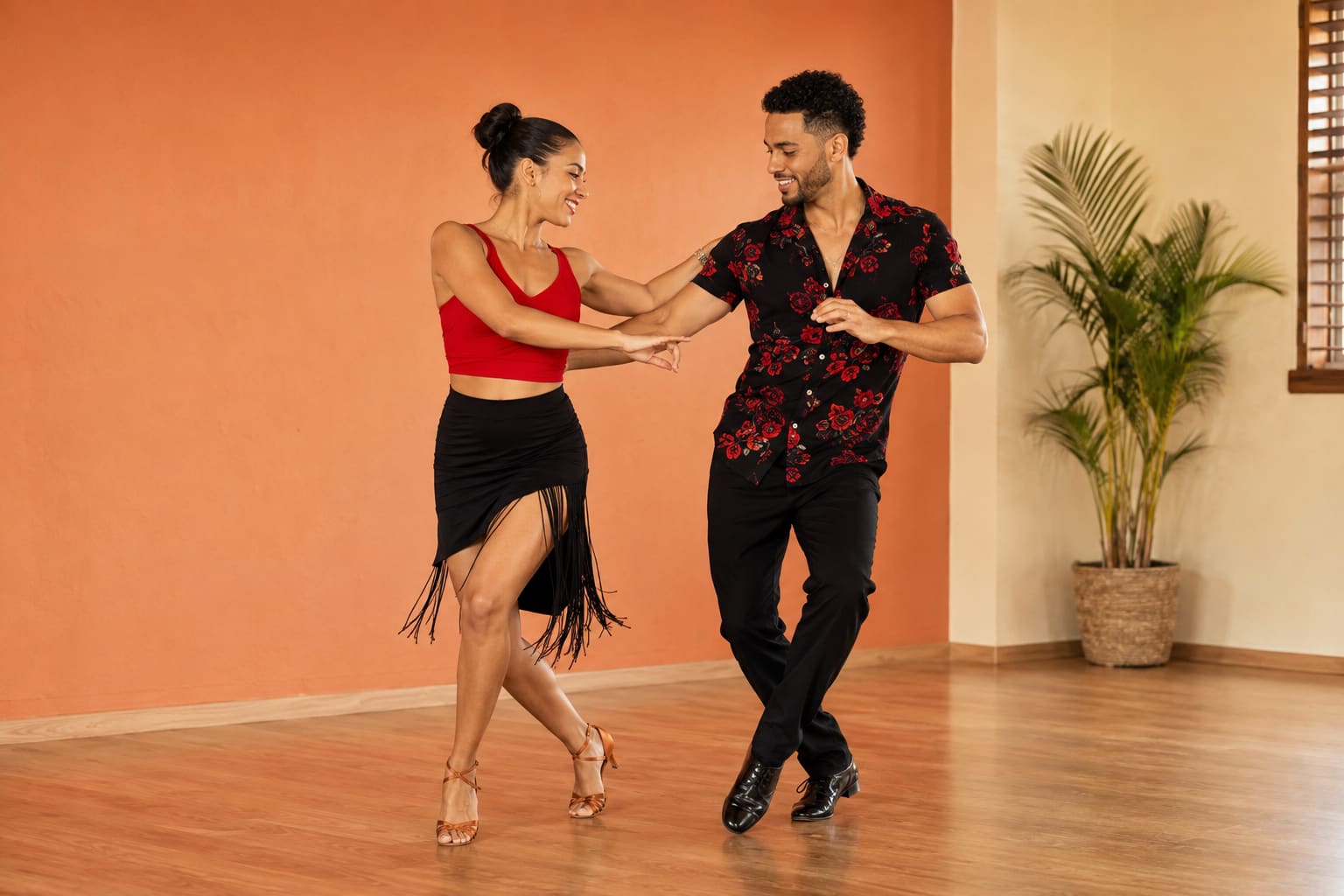
Dominican bachata is the broad home tradition rather than one frozen syllabus. Social dancers use compact basics, rhythmic footwork, turns, syncopations and changes between open and closer positions. Partners often play with the guitar and percussion rather than running long preset turn patterns. Use the beginner mambo footwork set to practise four small answers to the guitar and percussion without treating them as a fixed syllabus.
Outside the Dominican Republic, classes labelled “traditional bachata” often teach a footwork-heavy version of this approach. That can help, but it should not imply that every Dominican dancer uses the same steps or that a showy footwork sequence is more authentic than relaxed social dancing.
Bachata moderna or modern bachata
Modern bachata developed in international studio scenes by combining the side-to-side basic with turn patterns and framing familiar to salsa and other partner dances. You will see open holds, inside and outside turns, hand changes, wraps and travelling combinations.
This is often the easiest version to recognise in a general Latin dance school. It gives beginners a clear pattern vocabulary and works well at mixed salsa-and-bachata socials. The trade-off is that pattern-heavy dancing can lose the grounded rhythm of the music if dancers rush from one figure to the next.
If you are choosing between the two big social scenes, read our comparison of salsa and bachata for beginners.
Bachata sensual
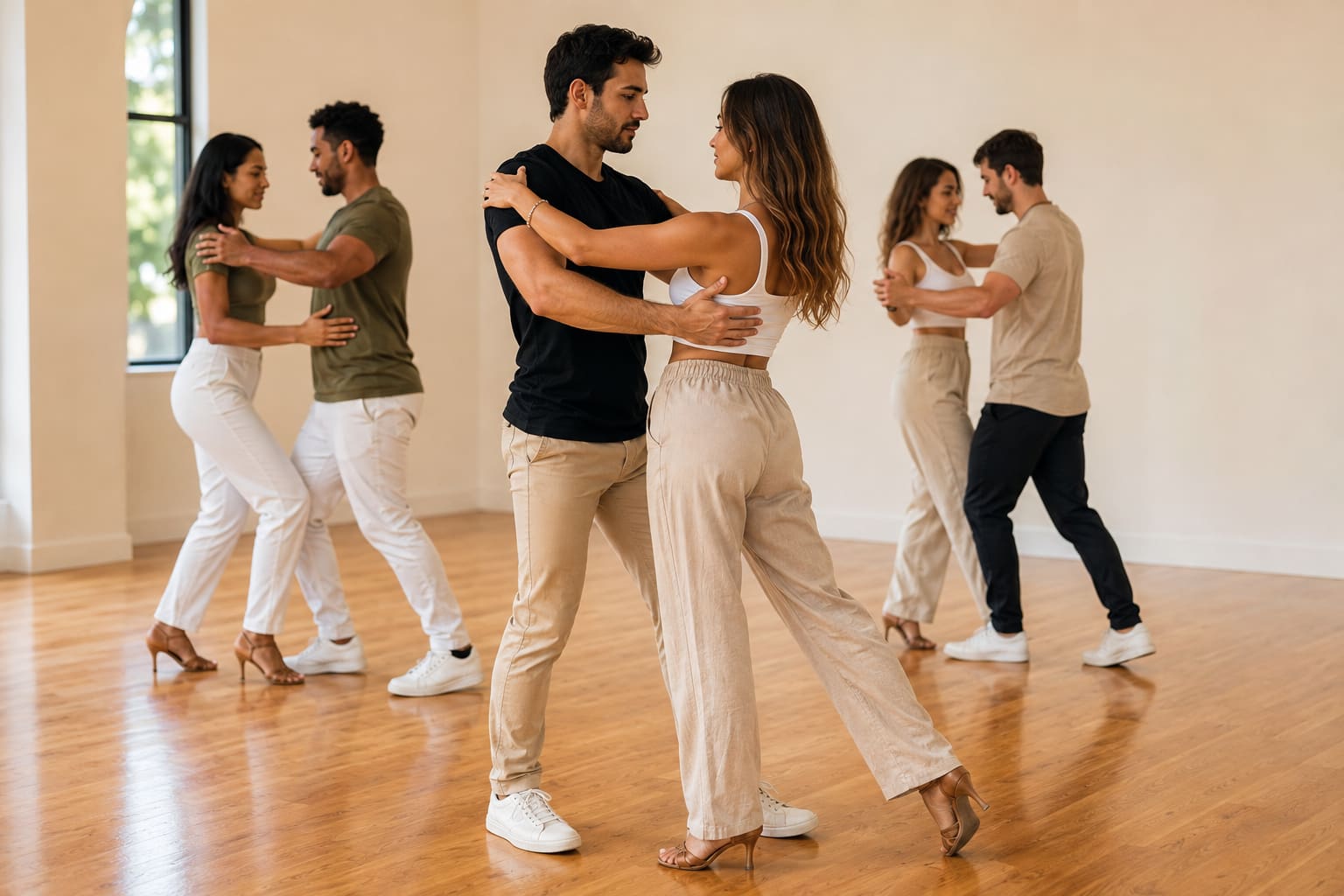
Bachata sensual was developed in Spain in the 2000s, with Korke Escalona and Judith Cordero closely associated with its early teaching system. It adds controlled waves, isolations, circular torso actions, counterbalances and changes of frame to a bachata base. Our Bachata sensual movement dictionary defines onda, onda lateral, completo and the other names you may hear in class.
Good sensual bachata is led through preparation, frame and shared balance. It is not a sequence of head rolls applied to every slow song. Neck and back movements need technique, appropriate range and clear consent. Either partner can reduce the movement, keep their head upright or decline a close position. Our Bachata connection guide compares open, closed and close-embrace holds and gives a clear way to change distance during a song.
DJs also play remixes and pop covers at sensual events. Those tracks can support long melodic movements, but they may remove some of the rhythmic detail that guides Dominican footwork.
Fusion styles: bachatango, bachazouk and beyond
Bachatango mixes bachata timing with tango-inspired shapes, hooks and dramatic pauses. Bachazouk borrows head movement, elastic connection and upper-body mechanics from Brazilian zouk. Teachers also blend bachata with hip-hop, contemporary dance and commercial choreography.
These are fusion practices, not stages in the historical development of Dominican bachata. They can be enjoyable and technically demanding, but the label should tell you what is being added so you can learn the source forms responsibly.
Bachata style comparison
| Style | Main emphasis | Common class content | Good starting point if you… |
|---|---|---|---|
| Dominican / traditional | Rhythm, footwork and improvisation | Compact basics, syncopation, turns and musical play | Like guitar-led music and active feet |
| Modern / moderna | Turn patterns and adaptable social vocabulary | Open hold, hand changes, wraps and travelling figures | Want a structured introduction at a Latin studio |
| Sensual | Frame changes, torso movement and melodic interpretation | Waves, isolations, counterbalance and close-position technique | Have a careful teacher and enjoy slower movement detail |
| Fusion | Vocabulary borrowed from another dance | Varies: tango shapes, zouk mechanics or staged choreography | Already understand the bachata basic and the added form |
How to choose a bachata class
- Listen to the music used in class. A “Dominican” class should teach you to respond to Dominican bachata, not only memorise fast steps.
- Look for progressive teaching. Body movement should be built from individual control before it is used with a partner.
- Ask how the school handles consent for close hold, dips, head movement and counterbalances.
- Choose the style danced at the socials you plan to attend, then cross-train when your basic timing is reliable.
- Avoid teachers who describe one international style as the improved or more advanced form of Dominican bachata.
A festival demo can show how a style looks at full size while hiding the conditions behind the clip. Our comparison of bachata festival demos and social dancing explains which qualities transfer and which depend on rehearsal or a clear floor.
You do not need to select one identity for life. Many social dancers use modern turn patterns, Dominican footwork and some sensual technique in the same evening. The better question is whether the movement fits the song, your partner and the room available. Our social dance etiquette guide covers the partner part of that decision.